Own eggs or donor eggs: how that decision gets made
When egg donation comes up, the real question is not which option is better, but in what order to ask the questions. What each path offers and where its limits are.
There is a sentence almost every patient who reaches IVF MORE® has heard before, in another consulting room: “with your own eggs it is no longer possible”.
Sometimes it is true. Often it is premature. And in nearly every case it is said without having measured the one thing that would settle the answer.
Why egg donation gets proposed
It is not an arbitrary recommendation. Egg donation solves in one move the problem no other step of the treatment solves: it puts a young egg into the equation, with its energy machinery intact and far less likely to mis-sort the chromosomes.
Its success rates are high and stable, and they do not depend on the age of the recipient, unlike what happens with a patient’s own eggs.1
That is why it gets proposed. And that is why, for many patients, it is the right decision.
What is actually being decided
What usually makes this conversation hard is not the statistics, it is that two different questions are getting mixed together:
-
01
The medical question
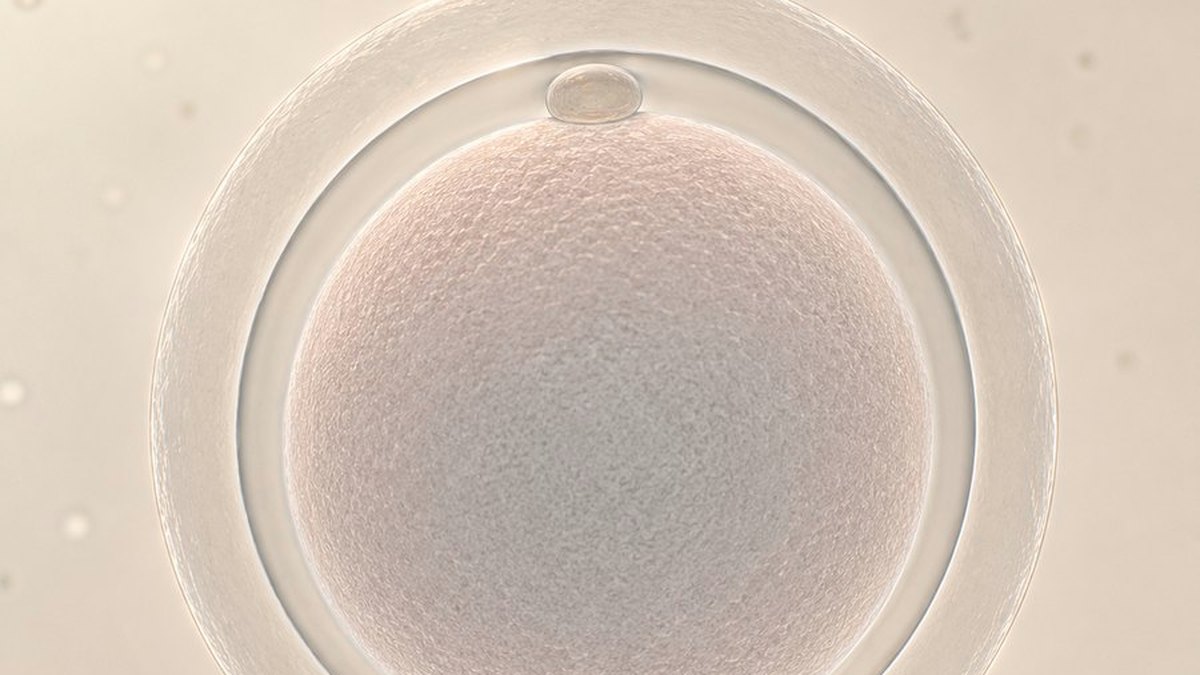
Can this egg produce a viable embryo? That is a technical question, and it has a measurable answer: ATP production, mitochondrial function, spindle structure.
-
02
The personal question
What does it mean to me whether the genetic material is mine or not? There is no technical answer, and nobody can settle it from outside.
-
03
The common mistake
Answering the second before measuring the first. Own eggs get given up without knowing what state they were in, or identical cycles get repeated without knowing why they failed.
What restoration changes, and what it does not
IVF MORE® was born in exactly that gap. If the egg fails for lack of energy, the question stops being which egg we use and becomes whether what is missing can be replaced.
The technique infuses growth factors and energy components into the cytoplasm, which is where the cell keeps its energy, and does not touch the nucleus, which is where the genetic information lives.2 The embryo that results carries your DNA.
Now the part that matters just as much:
Restoration is not always applicable.
It requires at least one mature egg. If none is produced, even with stimulation, there is nothing to work on. And even when there are eggs, some do not respond. When that happens, egg donation remains the most effective alternative.
This is reproductive medicine: it works with probabilities, not guarantees. Anyone promising you otherwise, with your own eggs or with donor eggs, is selling you something.
An order that does work
Rather than choosing between two paths blind, it helps to ask the questions in this order:
- How many mature eggs can be obtained? One is enough to attempt restoration, though more gives more room.
- What metabolic state are they in? This is what almost never gets measured, and it is what decides whether persisting with your own eggs makes sense.
- What does that diagnosis say? If they are recoverable, restore them. If not, egg donation stops being a surrender and becomes an informed decision.
- What do you want? With the data in front of you, not before.
Around one in six adults worldwide experiences infertility at some point.3 Very few of them reach this decision with the full picture, and that is the part that can actually be fixed.
What the metabolic diagnosis measures · What the treatment costs
Scientific sources3
- (2022). Live births per intended egg retrieval, national summary report. SART CORS.
- (2015). Autologous Germline Mitochondrial Energy Transfer (AUGMENT) in Human Assisted Reproduction. Seminars in Reproductive Medicine.
- (2023). 1 in 6 people globally affected by infertility. WHO.
Next steps
Take the first step toward your baby with IVF MORE®
Our team is ready to support you every step of the way.